How Quality Certifications Improve Reliability in Fabrication Services
In metal fabrication, reliability is synonymous with safety, performance and operational
value. Quality certifications are a testament to the company’s quality and expertise. In
industries as a whole and metal
fabrication in
particular, where precision and safety
are non-negotiable, quality certifications will further enhance the company’s image
and
provide an assurance to the customers about its products and services.
In this blog, we will discuss how quality certifications enhance the reliability of
fabrication services.
What are Quality Certifications?
Quality certifications are formal approvals issued by recognized organizations that
confirm the company’s compliance with industrial standards. These certifications are an
assurance that the products and services offered by the company are reliable and of high
quality.
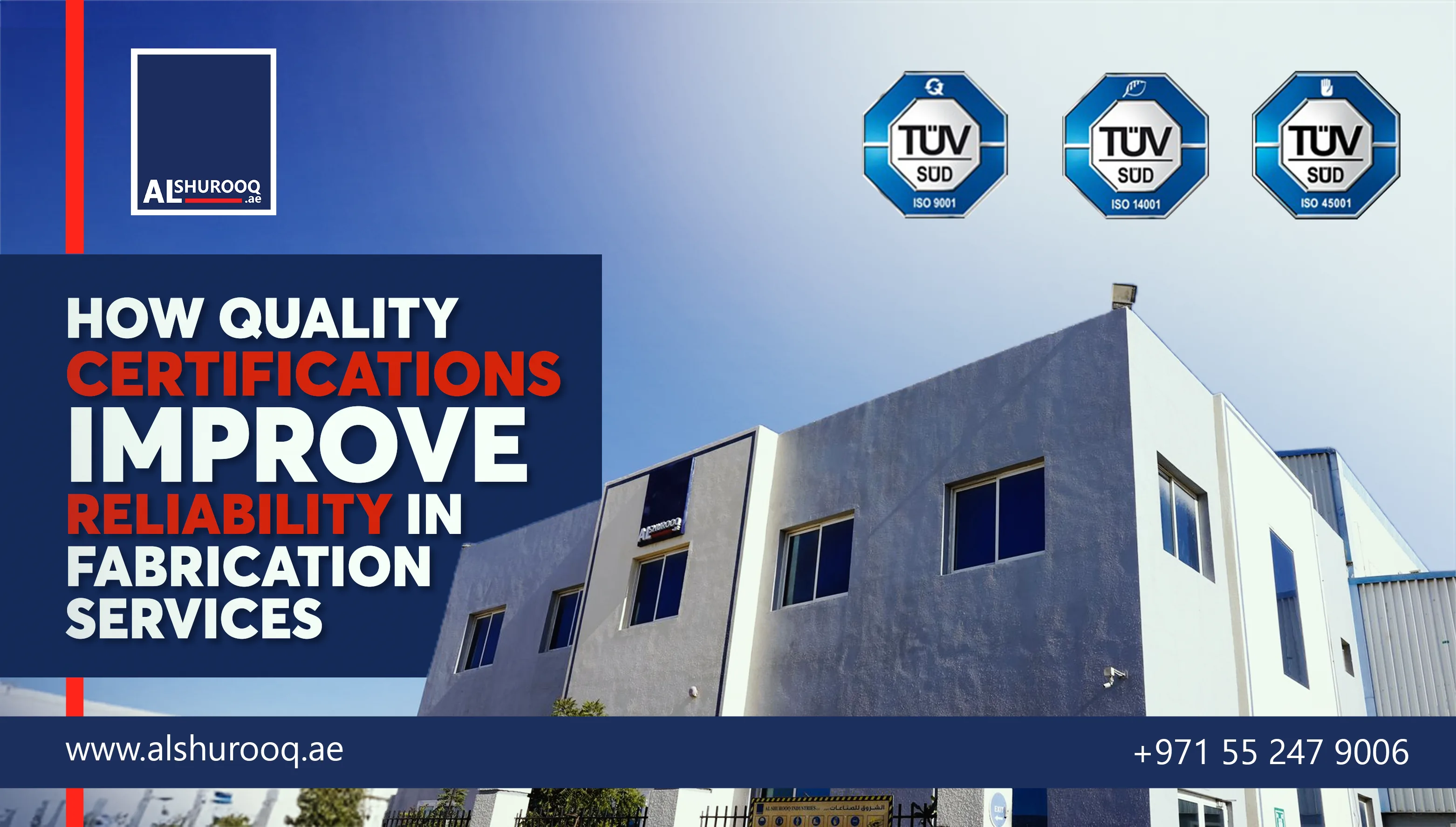
The common quality certifications relevant to the fabrication industry are as
follows:
- ISO 9001:2015: As the international standard for quality management
systems, this
certification implies that the organization delivers high-quality products and
services, ensures customer satisfaction and takes proactive risk management
schemes.
- ISO 14001:2015: This certification confirms that the company’s strategies
and
policies are sustainable and environment-friendly.
- ISO 45001:2018: It helps organizations to proactively improve workplace
safety,
reduce risks, and prevent work-related injuries and illnesses.
Why certifications Matter
Builds Trust and Credibility
Every successful business thrives on trust. Quality certifications build trust as they
confirm that the company or organization is compliant with the industrial standards and
reliable. Customers are more likely to approach a certified company that is committed to
excellence, performance and transparent operation.
Organizes the Production
Certification prompts businesses to adopt systematic procedures to ensure safe and
proper operation. This mandates constant monitoring and improvement, thereby enhancing
the overall efficiency of the workforce on a whole.
Increased Customer Satisfaction
As mentioned earlier, certifications aren’t just mere declarations, they are concrete
evidence that testifies that a company is trustworthy and dependable. Customers always
prefer companies that consistently deliver high-quality products and services. This will
promote brand recall and loyalty.
Enhanced Product Quality
Certifications, particularly the ISO 9001, ensure that all the products meet the
industrial quality standards and are safe and durable. As far as fabrication companies
are concerned, this certification is proof that their products are of high quality,
produced with fewer defects and minimal rework. By tuning into a systematic upgrade and
monitoring of the production process, companies can maintain high-quality output.
Safety Compliance
Certifications actively contribute to reducing errors and failures. In fabrication
environments, this is crucial. It ensures fewer production errors, accidents and other
instances that contribute to downtime, thereby ensuring workplace safety.
Marketing Advantage
Certification strengthens businesses and gives them an upper hand amongst the
competitors. This highly influences partnership eligibility, accelerating the
trust-building process and the subsequent client-approval.
Conclusion
Certifications are vital for the fabrication industries. They ensure operational
efficiency and forge trust among customers. Complying with the international standards,
companies show their commitment to quality, safety and consistent upgrades. This creates
a competitive advantage in this increasingly demanding market.