Choosing the Right Cutting Process for Your Fabrication Project: Laser, Waterjet, and
Plasma Cutting
Selecting the right cutting processes such as Laser, Water jet, or Plasma cutting etc.
goes beyond just choosing the fastest or most straightforward process. It is about
understanding the fabrication project at hand, its requirements, and selecting the best
available process that gives the right throughput. This blog will walk you through these
three key fabrication processes and provide you with the insights to select the
efficient approach to achieve better results.
A. Understanding the Cutting Process
- Laser Cutting
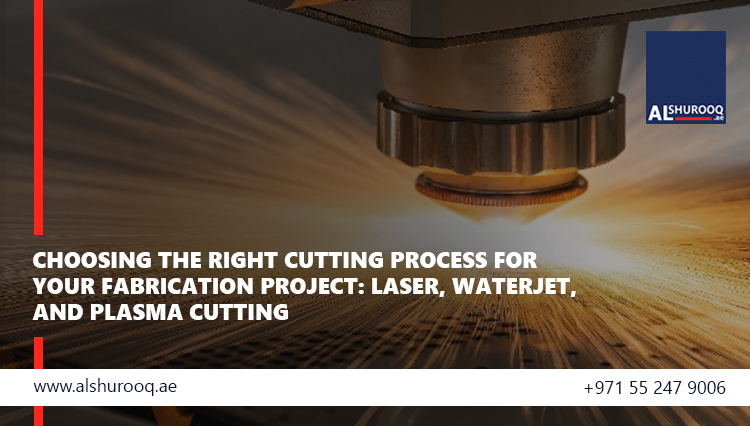
Laser cutting utilizes focused beams to cut through a variety of materials
such as metals, non-metals and plastics. The laser melts, vaporizes, or burns the
materials to make precise cuts. The molten material is blown away using an assist
gas, usually Oxygen or Nitrogen Gas; which then cools the area. The laser beam’s
path is directed by the CNC control and drives that ensures precision cuts.
This process is suitable for processing materials from thin to medium thickness,
typically up to 30 mm. It is a non-contact process that offers fast, accurate, and
clean cuts, making it an ideal choice for fabrication that requires fine attention
to detail.
Advantages of laser cutting
- Laser cutting produces more intricate designs and holes with utmost precision.
- As it delivers cleaner cuts, the need for additional or secondary finishing
process is eliminated.
- Since it is a non-contact process, it effectively avoids costly tool setup and
material distortion.
- Waterjet Cutting
Water jet cutting is yet another important fabrication process that uses a
high-pressure stream of water mixed with an abrasive material to cut almost all type
of materials except tempered glass.
A high-pressure pump pressurizes the water, which then flows into the mixing tube of
the cutting head. This water is ejected out through the nozzle to produce precise
cuts. The water jet cutting machines can typically produce pressure as high as 6,000
bars.
This process enables the accurate cutting of materials such as metals, non-metals,
plastics, stone and tile, composites, glass, and ceramics.
Advantages of waterjet cutting
- Since the process utilizes high-pressure water, it effectively eliminates the
heat-affected zones.
- Water jet cutting delivers high finishing and superior edge quality, hence there
will be no need for any secondary finishing processes.
- This process requires no tool changing for new workpiece, as the cutting is done
with the pressurized water stream.
- A water jet stream can create multiple cuts apart from the standard
straight-line cut.
- Plasma Cutting
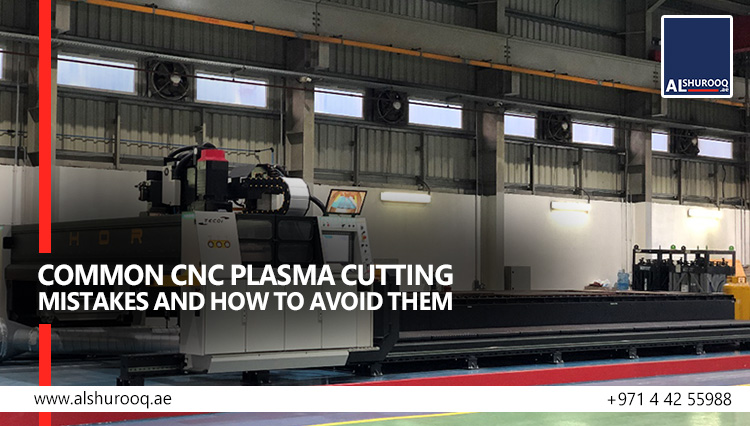
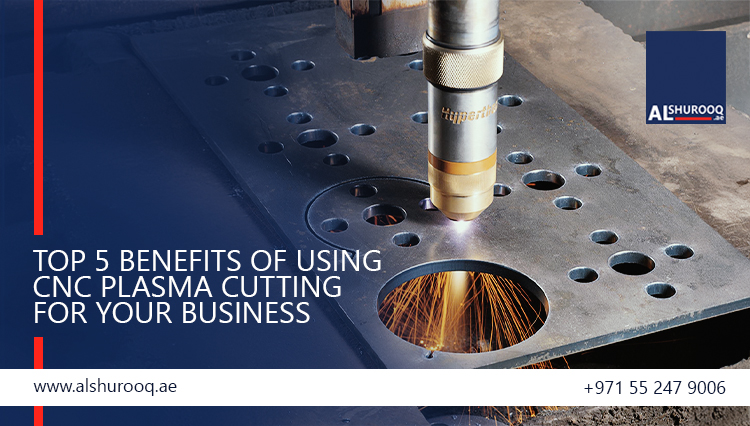
Plasma cutting is the process of cutting material using an electric arc that
pass through a gas turning it into plasma. As the electric arc is struck between the
electrode and the workpiece, the gas is ionized, and a plasma stream is produced.
This high-velocity plasma stream is directed to the metal, which will be melted
instantly. The continuous stream blows away the molten metal, forming the cut.
Plasma cutting can process any electrically conductive metal such as Steel,
Stainless Steel, Aluminum, Copper, Brass, and Titanium.
Advantages of plasma cutting
- It cuts at high speeds, especially on thin materials, which boosts productivity
and reduces costs.
- It can cut various electrically conductive metals like Steel, Stainless Steel,
Aluminum, and Copper.
- This process can be used for gouging or welding.
- Plasma can cut through material with poor surface finish such rust, paint, or
coatings.
B. Choosing the Right Process
When it comes to the fabrication industry, there is no one-size-fits-all process.
Choosing the right process needs to consider the following factors:
- Material compatibility:
Whether the process suits the properties and type of material in question.
- Thickness and precision range:
The type and range of material thickness that can be handled and the accuracy of the
process.
- Edge quality and finishing:
Smoothness and the requirement of post-processing. Laser and waterjet cutting
typically deliver smooth cuts and precise edges, while plasma cutting may require
post-cut finishing, especially in the case of thick materials.
- Cutting speed and output:
How fast the process can offer the proper fabrication of workpieces, which tends to
vary according to the material type.
- Automation and Integration with software:
All three cutting process can be automated with an advance CAD and Nesting software.
Laser cutting is the most compatible, exhibiting excellent integration with the
software, while water jet cutting and plasma cutting are also highly automatable.
C. Conclusion
Choosing between the laser, waterjet, and plasma cutting is about
carefully considering what process best suits the material, its tolerance, and the
production speed. Al Shurooq
Industries is a trusted metal fabrication and machining company; offering high-end CNC
cutting and processing services that are precise, efficient and tailored to your project
requirements.